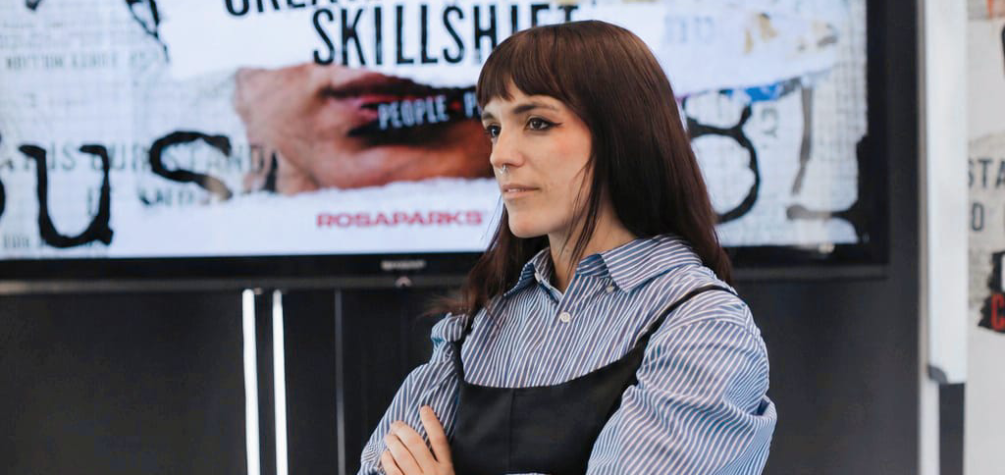
An interview with Alba Guzmán, Co-founder and Co-director of ROSAPARKS
ROSAPARKS has concluded the first edition of BUS84 with an excellent reception among its participants. Conceived as a skillshift for communication professionals, the program was born from the need to connect sustainability, creativity, business, ethics, and reputation in a context marked by new regulatory and social demands.
Contents
- ROSAPARKS has just concluded the first edition of BUS84 with an extraordinary evaluation. Why did you decide to create this program?
- Why do you define BUS84 as a skillshift and not as conventional training?
- One of the ideas that runs through all of BUS84 is that “narratives create reality.” What does that mean exactly?
- Can communication really accelerate the transition toward more sustainable models?
- The BUS84 faculty brought together profiles from Unilever, L’Oréal, WWF, Oxfam Intermón, DKV, Veritas, B Lab Spain, La Fageda, Clean Creatives, and Revuelta, among many others. What were you looking for by gathering such diverse voices?
- The program results have been excellent. What surprised you most about this first edition?
- Many participants state that BUS84 has made them question their way of working. Was that the objective?
- What does BUS84 represent for ROSAPARKS?
- Do you think we are witnessing the birth of a new discipline within communication?
- To finish, what would you say is the greatest risk for a brand today: doing too little or communicating poorly?
In this interview, ROSAPARKS delves into the power of narratives to transform behaviors and build new collective imaginaries. “Those of us who work in communication don’t just tell stories. We help decide which stories end up becoming part of society,” she emphasizes. A responsibility that forces the sector to review its certainties and move toward a more coherent, rigorous communication capable of turning purposes into facts.
ROSAPARKS has just concluded the first edition of BUS84 with an extraordinary evaluation. Why did you decide to create this program?
Because we detected something that concerned us. Organizations are changing at great speed. Regulation is advancing, social expectations are increasingly higher, sustainability has ceased to be an accessory issue to become a strategic element… and yet, those of us who work in communication continue to train, in many cases, with frameworks designed for another reality.
There is a lot of training on sustainability and a lot of training on creativity, but practically none that addressed the intersection between the two.
We didn’t want to create another course. We wanted to drive a change in perspective. That’s why we talk about a skillshift. It wasn’t just about acquiring knowledge, but about developing new capabilities to practice the profession in a completely different context.
Because communicating sustainability does not consist of adding a green discourse to a campaign. It requires understanding the business, regulation, reputation, creativity, ethics and, above all, the enormous power that communication has to influence society.
Why do you define BUS84 as a skillshift and not as conventional training?
Because we believe that the great challenge is no longer learning to do better what we did before.
The challenge is to unlearn certain inertias and acquire a new way of understanding our work.
For many years, the success of a campaign was measured by its notoriety, its creativity, or its commercial results. Today that is no longer enough. We must also ask ourselves what behaviors it encourages, what imaginaries it builds, what conversations it generates, and what impact it leaves on society. That change in perspective is precisely the skillshift.
We don’t just teach tools. We try to help each professional leave the program asking themselves better questions.
One of the ideas that runs through all of BUS84 is that “narratives create reality.” What does that mean exactly?
I think that for a long time we have underestimated the power of communication.
Brands don’t just sell products. They also normalize behaviors, build role models, generate aspirations, and shape culture.
When a brand decides which bodies appear in a campaign, how it represents diversity, what it understands by success, beauty, or progress, it is doing much more than communicating a product. It is participating in the construction of the collective imaginary.
That’s why I always say that those of us who work in communication don’t just tell stories. We help decide which stories end up becoming part of society. And that implies an enormous responsibility.
Can communication really accelerate the transition toward more sustainable models?
I am convinced of it. For years we have talked about sustainability as a technological, legislative, or business challenge. All of that is essential, but there is an equally important element: the ability to generate desire. People change when we understand, but also when we connect emotionally with an idea. Creativity plays a decisive role there. Communication can turn sustainability into something relatable, inspiring, and aspirational. It can accelerate behavioral changes, generate trust, and make new business models visible.
At ROSAPARKS, we have been working for years around a concept we call Impact Marketing. We believe that marketing should not be limited to selling more, but to creating more value for people, for society, and for the planet.
The BUS84 faculty brought together profiles from Unilever, L’Oréal, WWF, Oxfam Intermón, DKV, Veritas, B Lab Spain, La Fageda, Clean Creatives, and Revuelta, among many others. What were you looking for by gathering such diverse voices?
Precisely that diversity. Great challenges are never solved from a single discipline.
We wanted to seat people from large companies, NGOs, creative agencies, social movements, consultancies, universities, and entrepreneurial projects in the same classroom. And something beautiful happened. Each speaker added a new layer of reflection on top of the previous one. There were no closed speeches. There were conversations.
I believe that one of the great strengths of the program has been precisely that ability to demonstrate that positive impact does not belong to a single sector. It is a shared conversation. And, furthermore, I must say that we encountered something extraordinary: professionals of an impressive level who, far from giving a masterclass, also shared their doubts, their mistakes, and their contradictions with enormous generosity. That was deeply inspiring.
The program results have been excellent. What surprised you most about this first edition?
The data is very positive, of course. The overall evaluation and recommendation of the program have been extraordinary, and practically all participants have asked us for more time, more sessions, and a second edition. But, honestly, that hasn’t been the most exciting part. The most exciting part has been hearing phrases like: “As a professional, I’m starting to question many more things” or “Tomorrow I’m going to review a sustainability report with different eyes.” That’s when we understood that something had changed. Because the most valuable learning doesn’t consist of accumulating information; it consists of transforming the way you look at your profession.
Many participants state that BUS84 has made them question their way of working. Was that the objective?
Absolutely. We didn’t want to fill heads with content; we wanted to shift certainties.
We live in a time of enormous complexity in which simple answers no longer exist.
That’s why we believe much more in generating critical thinking than in offering recipes.
When someone finishes the program asking themselves questions they didn’t ask before, we feel that the objective has been met. Because the best professional transformations always start with a good question.
What does BUS84 represent for ROSAPARKS?
It is probably the project that best represents who we are. At ROSAPARKS, we accompany organizations to develop communication strategies capable of generating a positive impact, but we also feel that we have a responsibility to our own profession. It’s not enough to transform brands. We must also contribute to transforming the sector that helps build them. That’s why I usually say that BUS84 is our storydoing. We don’t talk about changing communication; we try to do it.
And, personally, it is one of the projects I feel most proud of since we founded ROSAPARKS. Because it brings together many of the things we deeply believe in: creativity, critical thinking, collaboration, shared learning, and the will to leave a positive mark.
Do you think we are witnessing the birth of a new discipline within communication?
Yes. And, paradoxically, I believe that in a few years it will cease to exist as a specific discipline. Today we talk about sustainability communication because we still perceive it as a specialization. But I am convinced that a time will come when we will simply talk about good communication. A communication that integrates purpose, impact, creativity, rigor, transparency, regulation, and business naturally.
Sustainability will stop being a suffix and become a necessary condition.
And those who understand that change first will be the ones leading the communication of the future.
To finish, what would you say is the greatest risk for a brand today: doing too little or communicating poorly?
Today the risk is inconsistency. A few years ago, communicating well was enough. Later we understood that it was essential to do things well. Today we need both.
Organizations are subject to an unprecedented level of scrutiny. Transparency is no longer an option. Trust is built by demonstrating, not by declaring. That’s why communication has stopped being a storefront and has become a test of consistency.
And perhaps that is the greatest lesson of BUS84: that creativity remains one of the most powerful tools to transform the world, but only when it is at the service of an authentic purpose and real actions. Because stories matter, but organizations that are capable of turning those stories into facts matter even more.
Find more responsible information in the Corresponsables publications and in the ROSAPARKS Profile in the 2026 Corresponsables Yearbook.